Lesson 46 — The DriverProcess Logic: Upsert into a Composite-Key RocksDB Store
The Naive Approach — And Why It Dies at 10k Drivers/sec
A typical engineer models driver location like this:
// Naive: KTable keyed by driverId
store.put(driverId, new DriverLocation(lat, lng));
This compiles. It runs in dev. It collapses in production for two independent reasons.
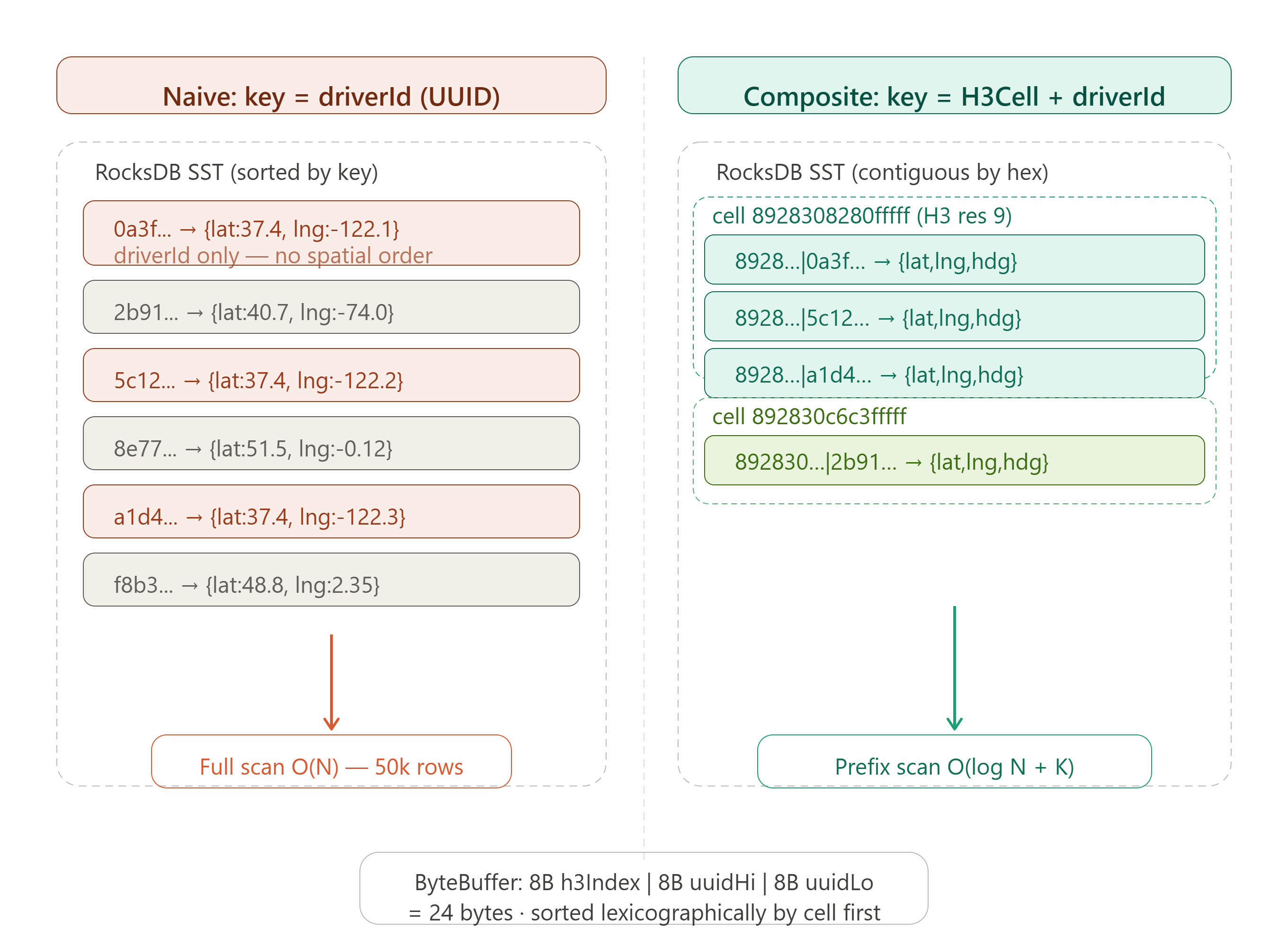
Reason 1: O(N) matching. A rider requests a pickup. Your matching engine needs all drivers within ~1 km. With a
driverId-keyed store, there is no spatial index. You iterate every entry and compute distance. At 50,000 active drivers, that is 50,000 deserialization + Haversine calls per rider request. At 200 rider requests/sec, that is 10M operations/sec — on a single StreamThread — before it has processed any driver events. Theprocess-latency-maxmetric will flatline your Grafana dashboard around 8,000 drivers.Reason 2: Ghost drivers. A driver moves from cell
Ato cellB. Youput(driverId, newLocation). The old record is overwritten. Fine for a simple KV lookup. But once you switch to the correct composite key design (explained below), the old composite key(cellA, driverId)is never deleted. Within 90 seconds of a 3,000-event/sec stream, you accumulate tens of thousands of stale entries — ghost drivers that appear to be at locations they left long ago. Your matching engine dispatches riders to phantoms.Both failures are architectural. You cannot patch them with tuning.
The Uber-Lite Architecture — Inverted Spatial Index in RocksDB