A hands-on, code-every-day course for engineers who know what Kafka is but have never run it under real load.
You’ve read the tutorials. You can explain topics and partitions on a whiteboard. But when consumers start rebalancing at 2 a.m., theory doesn’t help. This course gets you there by building one real system, day by day, with working code in every lesson.
Days 1–3 are free. No card needed.
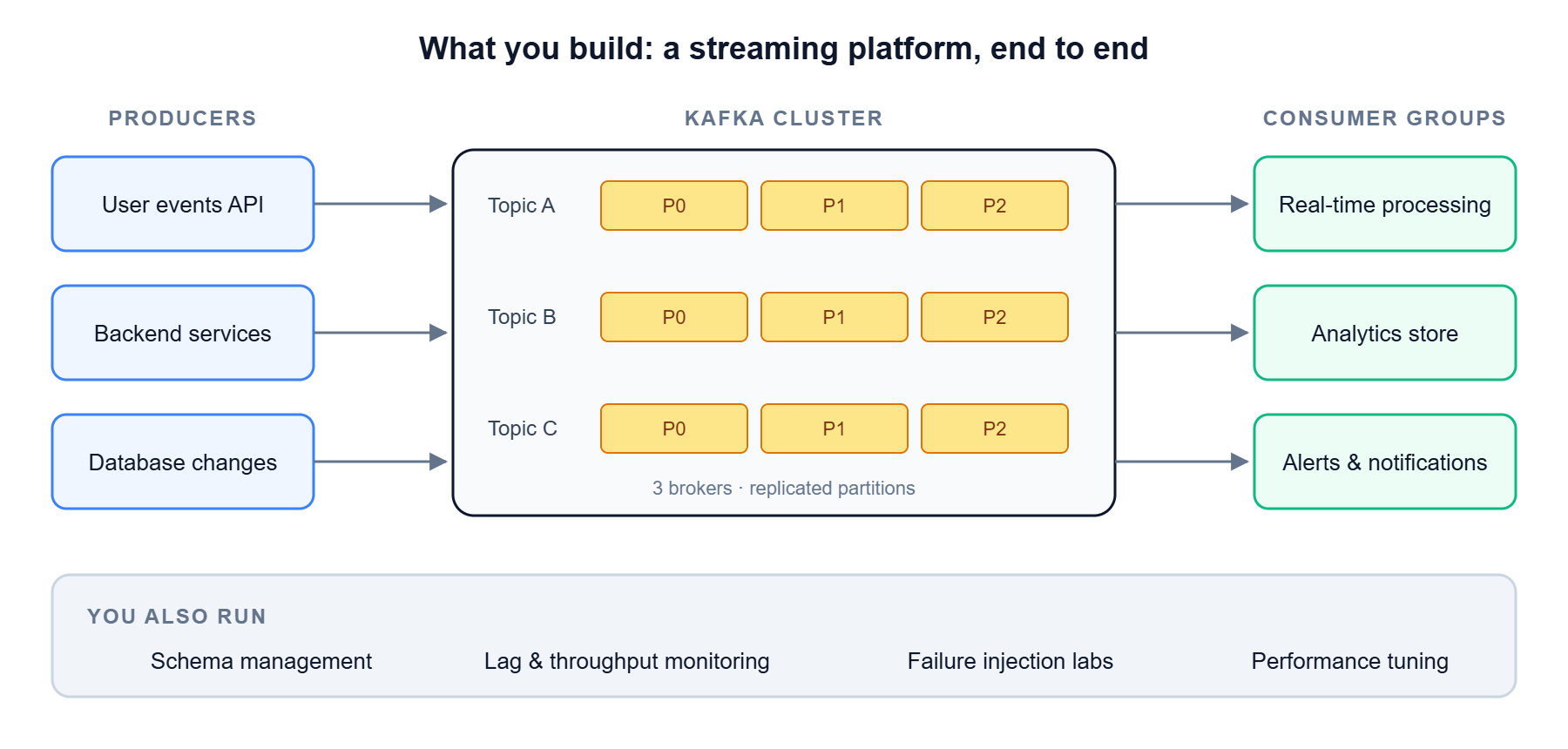
The system you build across the course: real producers, a multi-broker cluster, consumer groups, and the monitoring to run it.
THE PROBLEM
You already know the “hello world” of Kafka. One producer, one consumer, one topic on localhost. It works, and it teaches you almost nothing about production.
The real questions come later. Why is consumer lag climbing? Why did a rebalance stall the whole group? How many partitions is too many? What actually happens when a broker dies mid-write?
Free tutorials stop before those questions. Docs answer them one config flag at a time, with no system to try them on.
So you learn Kafka the expensive way: during an incident, on someone else’s cluster, with people watching.
THE SOLUTION
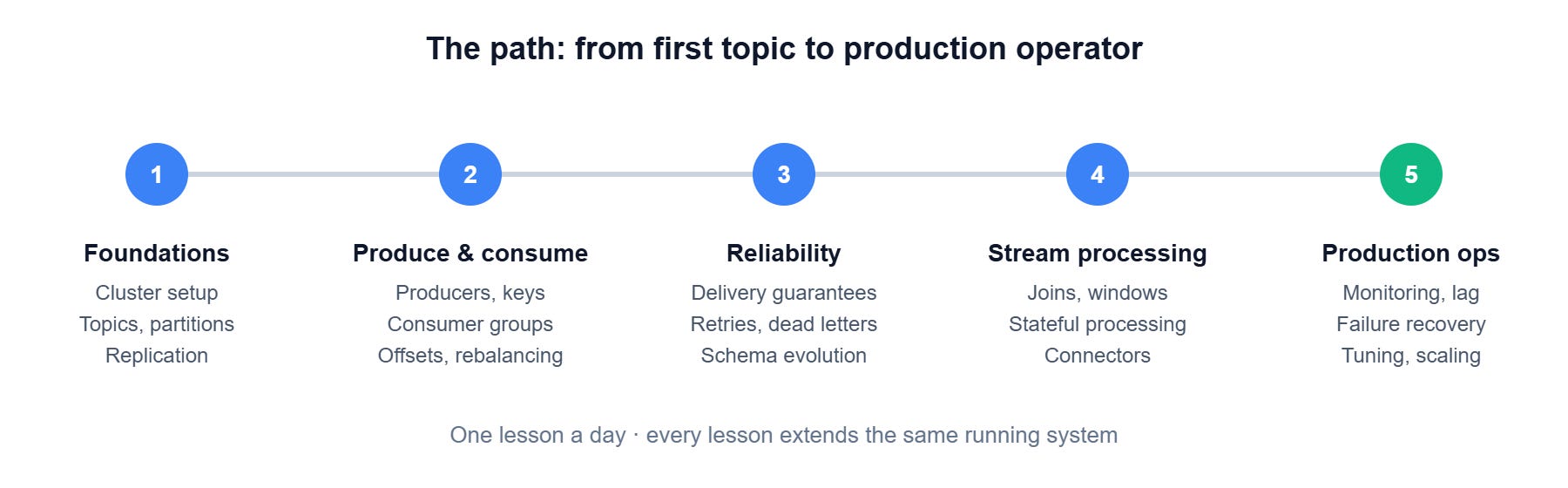
Hands On Kafka is a daily build. Each lesson adds one working piece to the same system, so by the end you have run, broken, and fixed a real streaming platform on your own machine.
You ship code every day — each lesson ends with something running, not a reading list.
You learn by breaking things — kill brokers, stall consumers, and overload partitions, then fix them.
You understand the “why” — every config choice is explained by the failure it prevents.
You finish with proof — a complete project and repo you can walk through in an interview or design review.
You get faster at debugging — lag, rebalances, and duplicates become things you have seen before.
WHAT YOU GET
Included Details Daily lessons One focused build per day, delivered to your inbox Working code Complete source and setup scripts for every lesson One real system Each day extends the same project instead of throwaway demos Failure labs Guided exercises where you break the cluster and recover it Diagrams Clear architecture visuals for every concept Paid subscriber comments Ask questions on each lesson and get answers with 2-3 days.
Free: Days 1–3 in full, plus the concept section of every lesson. Paid: All code, labs, and the complete archive. [$389/399: price per month / year]
WHO THIS IS FOR
You’re a great fit if you’re a backend engineer, SRE, or DevOps engineer who will own or use Kafka at work.
You’re a great fit if you learn best by writing and running code, not watching videos.
You’re a great fit if you’re preparing for system design interviews and want real depth on streaming.
This is NOT for you if you have never written a backend service. Start with fundamentals first.
This is NOT for you if you want a certification cram sheet or slide-only overview.
This is NOT for you if you can’t spare about [: 60–75] minutes a day to build.
SOCIAL PROOF
Testimonials -
“it is very rare to find courses which teach software concepts from a real world practical standpoint i look forward to subscribing to your other courses in the future”
Subscriber count - 9,500 Active Readers
Fortun 500 Companies & Where as tech roles, primariely software engineers.
From the team behind Hands On System Design and Systemdr’s production-focused engineering courses.
Build the Kafka experience your job will eventually demand, before the incident does.
Every week you wait is another week of knowing Kafka only on paper. Start with Day 1 today and have a running cluster by tonight.
[Start building with Day 1 →]
Cancel anytime. Keep everything you’ve built.
FAQ
How much Kafka do I need to know already? None. Day 1 starts from setup. But the course moves quickly into production topics, so experienced engineers stay engaged.
What language is the code in? [ Java / Python]. The concepts carry over to any client.
How much time does it take per day? About [ 60–75] minutes. Lessons are sized to fit before or after work.
What do I need to run it? A laptop with Docker. Everything runs locally. No cloud bill.
What if I fall behind? Every lesson stays in the archive. Go at your own pace and pick up where you stopped.
What’s free and what’s paid? The first three days and the concept sections are free. Code, labs, and the full archive are for paid subscribers.
Can I cancel? Yes, anytime, from your Substack account.
Can my company pay? Yes. Substack provides a receipt you can expense. [team/group pricing]
Stop reading about Kafka. Start running it.
[Get Day 1 free →]